Logeion: Greek and Latin dictionaries in one lookup
Anyone who reads ancient philosophy or patristics with a dictionary knows the friction: one lexicon for the classical sense, another for the patristic, a third for the papyri, and a fourth to check how the word behaves in Latin. Four windows, four interfaces, and the thread of the argument lost somewhere in between.
Logeion, from the University of Chicago, removes that friction entirely, and costs nothing.
What it is
An aggregator of Greek and Latin dictionaries. A single query returns, stacked on one page, the entries from Liddell-Scott-Jones, Lewis & Short, the Dictionnaire grec-français of Bailly and several others, together with frequency data and occurrences in context.
Why it works as a source
Because comparing lexica is itself an interpretive act. Two dictionaries will order the senses of a word differently, and the order encodes a judgement about which use is primary. Seeing them side by side makes that judgement visible instead of invisible.
The frequency data serves a second purpose. A claim that a term is rare, or technical, or characteristic of one author, is checkable here in seconds — and such claims are made constantly in exegetical literature without any check at all.
How to use it
Look up the word before trusting the commentary. Commentaries compress; the lexicon shows the range that was compressed.
Read more than one entry. Where LSJ and Bailly agree, you are on firm ground. Where they diverge, you have found something worth a footnote.
Check frequency before calling a term significant. Significance claims about vocabulary are the easiest to make and the easiest to refute.
A caution about word studies
A dictionary gives the range of a word, not its meaning in a sentence. Meaning is fixed by context, and no amount of lexical data substitutes for reading the passage. Logeion makes the first step fast; it does not replace the second.
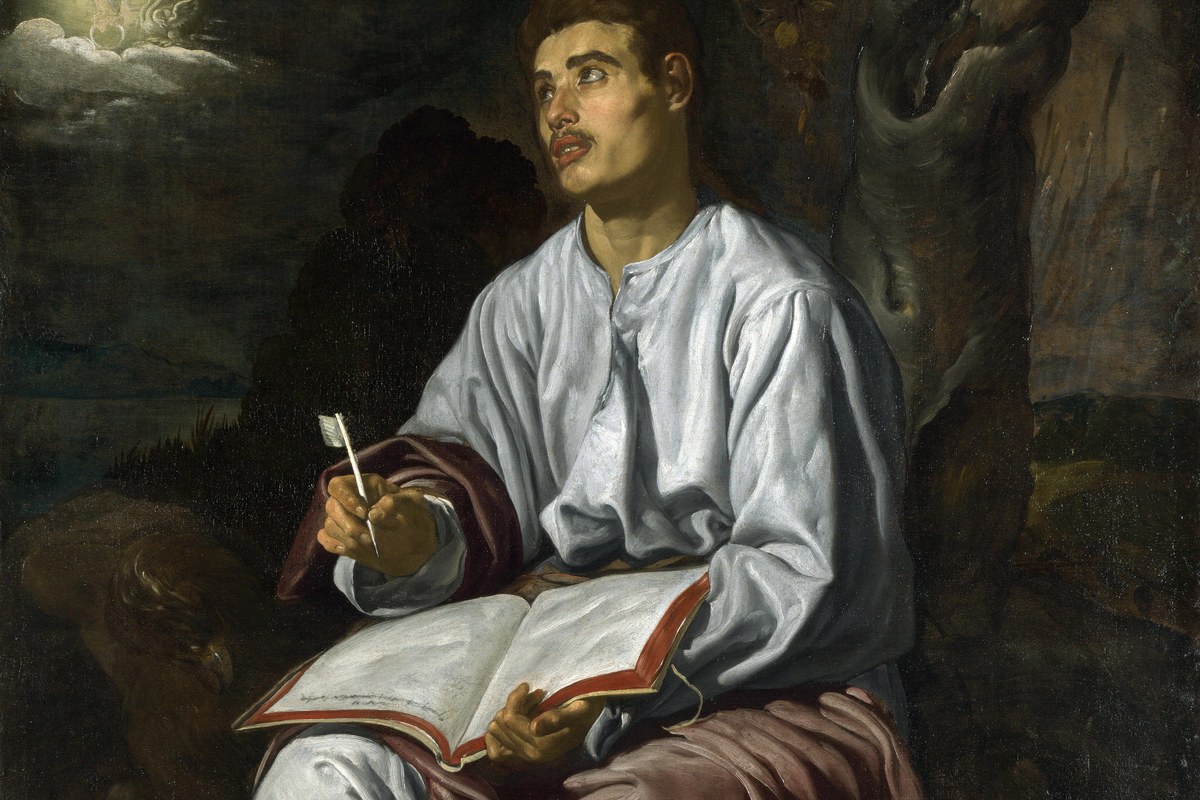
Image: Saint John the Evangelist on the Island of Patmos, Diego Velázquez, c. 1618. The National Gallery, London, public domain. John writes the Apocalypse in Greek, one weighed word at a time.