New Advent: The Complete Church Fathers, Free and Well Organized
A student who wants to read Athanasius tonight has two options. He can order a critical edition and wait three weeks, or he can open a browser and have the text in four seconds. That second option exists because of a quiet act of scholarly generosity: the digitization of the Schaff corpus, and its careful presentation at New Advent.
For anyone beginning serious work in patristics without institutional access, this is where the road starts.
What the Fathers Section Actually Contains
New Advent hosts the complete Ante-Nicene Fathers and both series of the Nicene and Post-Nicene Fathers — thirty-seven volumes edited under Philip Schaff in the late nineteenth century and long since in the public domain.
That range covers roughly six centuries of Christian writing: the Apostolic Fathers, Justin Martyr, Irenaeus, Tertullian, Origen, Cyprian, then the whole of the fourth-century flowering (Athanasius, Basil, the two Gregories, Chrysostom, Ambrose, Jerome, Augustine), and on into Leo, Gregory the Great, and John of Damascus.
Why the Presentation Matters
Several sites host the same public-domain texts. What distinguishes New Advent is the organization. Works are arranged by author and by title, each broken into chapters with stable addresses, and the pages are stripped of clutter. You can reach a specific chapter of De Civitate Dei in two clicks and cite it without hunting.
The site also preserves the original numbering of books, chapters, and sections. This is not a cosmetic detail. Patristic citation runs on that numbering rather than on page numbers, and a digital text that discards it is nearly useless for scholarship.
The Limits You Must Respect
Honesty about a resource is part of using it well, so here are the boundaries.
First, the translations are Victorian. They are competent and often beautiful, but they reflect the scholarship and the English of the 1880s. Where a passage carries real weight in your argument, check it against a modern critical edition before you build on it.
Second, the corpus is not complete. Schaff selected; whole authors and many individual works never entered the series, and the Syriac tradition is barely represented. Absence from New Advent is not evidence that a text does not exist.
Third, and most important: there is no Greek or Latin here. This is a translation library. When the argument turns on a word (and in patristic theology it frequently does), you will need the original, which lives elsewhere.
How to Use It Well
Read whole works rather than harvesting quotations. A patristic sentence detached from its argument becomes a slogan, and the internet is already saturated with slogans attributed to the Fathers that none of them would recognize.
Identify the opponent before you quote. Nearly every famous patristic line was written against somebody, and knowing who changes what the line means.
And cite by book, chapter, and section, never by web page. That reference will hold in any edition, in any language, for as long as the work survives.
Begin Tonight
If you have never read a Father straight through, start with Athanasius, On the Incarnation. It is short, it is electric, and it contains the argument that decided the fourth century: only God saves, therefore if Christ saves, Christ is God.
An hour tonight will teach you more about Christian doctrine than a month of secondary reading.
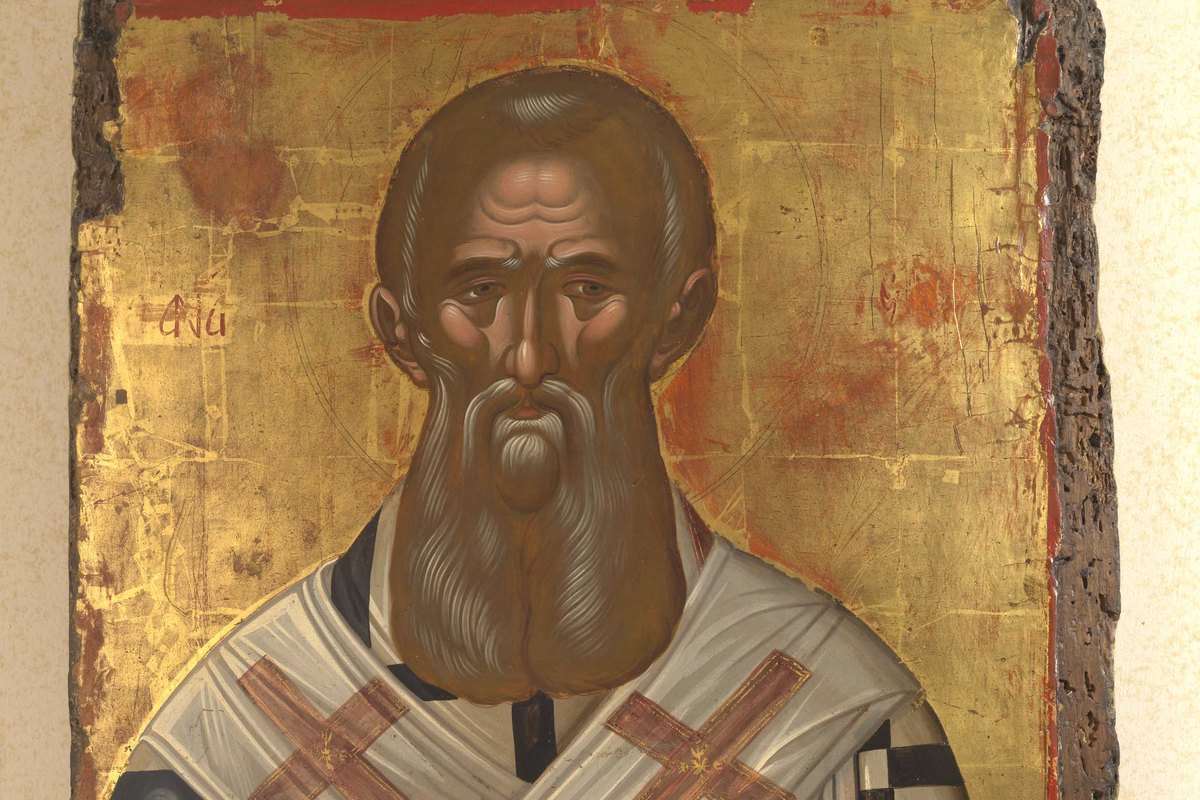
Image: Saint Athanasius, Michael Damaskinos, late 16th century, public domain. Athanasius of Alexandria, the defender of the faith of Nicaea.


