Documenta Catholica Omnia: Migne’s Patrologia, Digitized and Free
Between 1844 and 1866, a French priest named Jacques-Paul Migne did something no institution had managed: he printed, almost single-handedly and at ruinous speed, nearly the entire literary output of the Church Fathers. The Patrologia Latina ran to two hundred and seventeen volumes; the Patrologia Graeca to one hundred and sixty-one.
Scholars have complained about Migne’s editorial standards for a century and a half. They also cannot work without him. For a large number of patristic works, Migne remains the only place the original has ever been printed at all.
What Documenta Catholica Omnia Provides
The site has digitized the whole of Migne and offers it as free PDFs, volume by volume, alongside conciliar documents, papal texts, and other primary material. There is no subscription and no registration.
Consider what that means. A student anywhere in the world can now open the Greek text of a homily by John Chrysostom, or the Latin of a letter by Cyprian, without a research library, without a visa, and without spending anything. Fifty years ago that required a doctoral program in a wealthy country.
When You Actually Need It
Three situations send a researcher to Migne.
The first is when the argument turns on a word. Translations decide questions silently. If your point depends on how a Father used a particular term, you must see the Greek or the Latin, and for many texts this is where it lives.
The second is when the work has never been translated. The English patristic corpus is far smaller than the Greek and Latin one. Minor authors, occasional sermons, and vast stretches of commentary exist only in the original.
The third is verification. When a striking quotation circulates without a source (and patristic quotations circulate constantly without sources) Migne is where you go to find out whether the Father in question said anything of the kind.
The Honest Warnings
Migne worked fast and reprinted earlier editions rather than establishing texts from manuscripts. The result is uneven: some volumes reproduce excellent seventeenth-century editions, others reproduce poor ones, and the apparatus is thin throughout. Where a modern critical edition exists — in Sources Chrétiennes, in the Corpus Christianorum — cite that instead.
The scans are also images of nineteenth-century print in dense double columns, which means no reliable text search and slow reading. And the Greek is set in a ligature-heavy typeface that takes practice to read comfortably. None of this is a reason to avoid the site; it is a reason to know what you are handling.
A Recommendation for the Serious Reader
Do not begin here. Begin with a translation, understand the work, and only then come to Migne with a specific question about a specific passage. Used that way, it is the difference between quoting a Father and reading him.
And if you are building Greek or Latin, there is no better exercise than opening a page of Migne beside a translation you already know well, and working through a single paragraph.
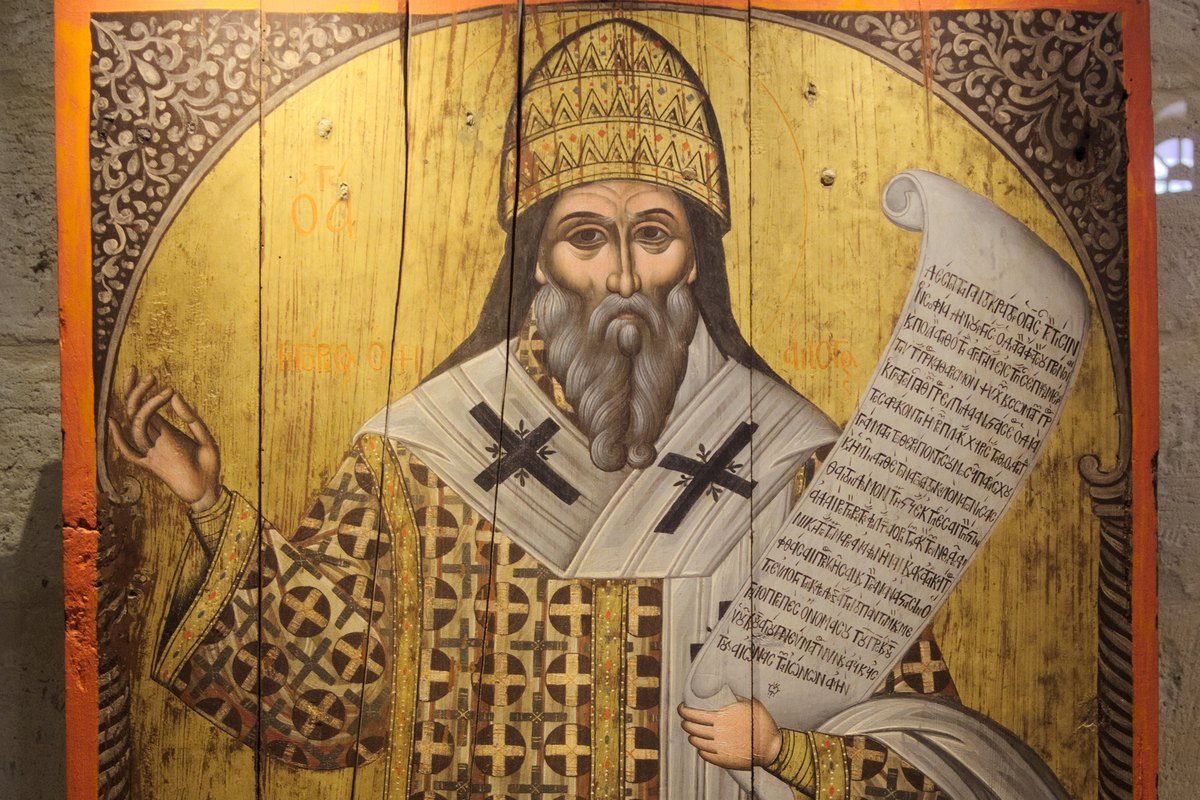
Image: Saint Gregory the Great, Cretan icon, second half of the 17th century. Collection of Saint Catherine, Heraklion, public domain. Gregory, the last of the four great Latin Fathers, whose works fill volumes 75 to 79 of Migne’s Patrologia Latina.


