
Sources Chrétiennes: The Gold Standard of Patristic Editions
In occupied France, in 1942, two Jesuits began a publishing project that would quietly reshape twentieth-century theology. Henri de Lubac and Jean Daniélou were convinced that the renewal of Christian thought would come not from new systems but from returning to the sources — and that the sources had to be made readable again.
The result was Sources Chrétiennes. More than six hundred volumes later, it remains the standard against which patristic editions are measured.
What a Volume Looks Like
Open any one and you find the same architecture. On the left-hand page, the critical text in Greek, Latin, or Syriac, established from the manuscripts with a full apparatus. On the right, a French translation. Before both, an introduction that can run to a hundred pages, setting out the author, the date, the manuscript tradition, and the theological stakes.
That facing-page arrangement is not a convenience. It is a claim about method: the translation is accountable to the original, and the reader is invited to check.
Why It Matters Even If You Do Not Read French
This is the objection I hear most, and it deserves a direct answer.
First, the left-hand page is not in French. If you are building Greek or Latin, the critical text with its apparatus is exactly what you need, and it is independent of the translation beside it.
Second, the numbering established in these volumes has become the reference system for the field. When an article cites a work by section number, that numbering frequently comes from here. Knowing the edition means knowing how to follow the scholarship.
Third, reading French passively is a far smaller investment than most students assume — a few months of steady work for someone who already reads Portuguese, Spanish, or Italian. For patristics it repays that investment many times over, because a great deal of the best scholarship has never appeared in English.
Its Place Among the Other Editions
A short orientation helps. Migne prints nearly everything but establishes almost nothing; use it when no better edition exists. The Corpus Christianorum, from Brepols, offers critical texts without translation and covers the Latin tradition with great thoroughness. Sources Chrétiennes sits between them: fewer works than Migne, but each one edited, translated, and introduced properly.
The practical rule for citation is simple. If a work appears in Sources Chrétiennes, cite that edition. If it does not, look to the Corpus Christianorum. Only when neither has it should Migne be your reference, and then say so plainly.
Where to Start
These are printed volumes, and they are not cheap. But the catalogue itself is freely searchable, and that alone is worth knowing: before writing on any Father, check whether a modern critical edition of the text exists and what its number is. That single habit will lift the quality of your references immediately.
For anyone working seriously on the fourth century, Basil’s On the Holy Spirit in this series is the volume I would buy first. It is the treatise that settled how the church speaks about the Spirit, and reading it with the Greek in view changes what you notice.
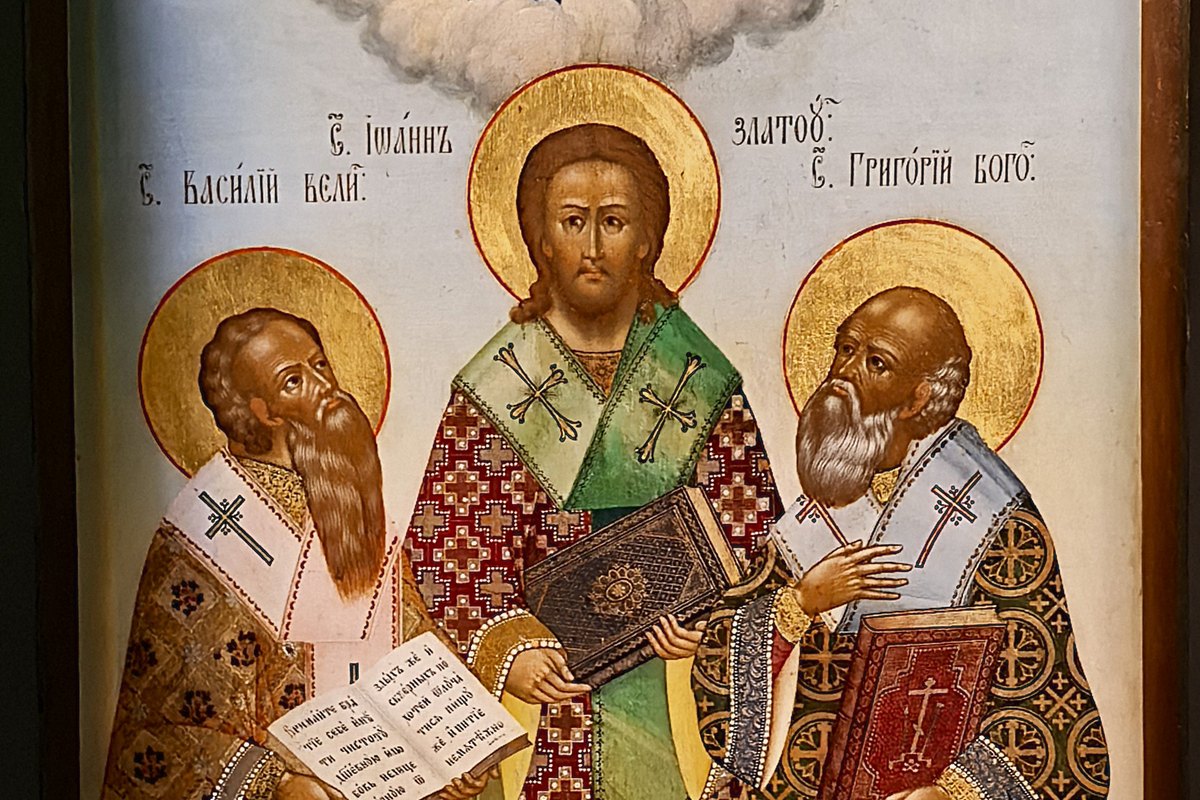
Image: Saints Basil the Great, John Chrysostom and Gregory the Theologian, Russian icon, second quarter of the 19th century, public domain. The Three Holy Hierarchs of the Greek Church, all three among the authors most represented in the collection.


