Perseus Digital Library: ancient philosophy in the original
There is a point in any serious study of ancient philosophy where translation stops being enough. A term is rendered three different ways by three translators, each defensible, and the argument you are reconstructing depends on which one is right. At that point you need the Greek.
The Perseus Digital Library, at Tufts University, puts it in front of you at no cost.
What it is
A digital library holding the Greek and Latin corpus in the original, with English translation alongside and — the feature that matters most — word-by-word morphological parsing linked to the standard lexica: Liddell-Scott-Jones for Greek, Lewis & Short for Latin.
Click a word and you get its form, its dictionary entry and its frequency. No prior command of the language is required to start; a little grammar is enough to make the tool useful.
Why it works as a source
Because it collapses the distance between reader and text. Plato, Aristotle, Cicero, Seneca, Epictetus, Lucretius and Diogenes Laertius are all there, and you can check any claim about what a passage says against the passage itself.
The texts are established scholarly editions, not transcriptions of unknown provenance, which is what makes the library citable rather than merely convenient.
How to use it
Check one word at a time. You do not need to read the dialogue in Greek. Checking the three or four terms that carry your argument is already a different level of work.
Compare the translation with the parse. Where they diverge, you have found an interpretive decision, and those are the places where philosophy happens.
Use the frequency data. Knowing that a word appears twice in a corpus, or four hundred times, changes what you can claim about it.
Why this matters for theology
The New Testament was written in the Greek of this world, and the vocabulary of the first Christian centuries is the vocabulary of these authors. Reading them in the original is not a luxury for the exegete: it is the context in which the biblical text was first heard.
Open the Perseus Digital Library
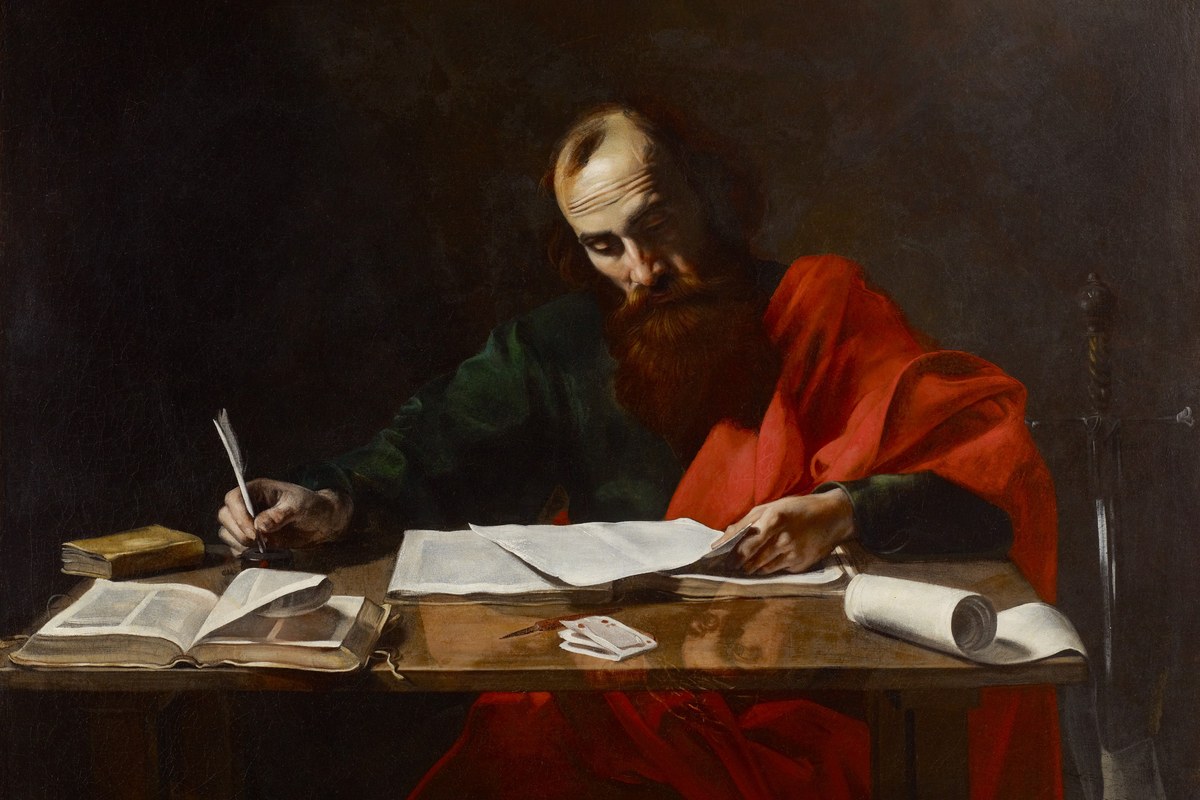
Image: Saint Paul Writing His Epistles, Valentin de Boulogne, c. 1618-1620. Sarah Campbell Blaffer Foundation, Houston, public domain. The apostle writing in Greek, the language Perseus keeps open in the original.