“Why Sit We Here Until We Die?”: Faith, Action, and Divine Providence in 2 Kings 7:3–11
“Action moves the heart of God.” This slogan is quite popular in Christianese circles, and you have surely heard it somewhere. Beyond finding no clear biblical support, it sounds like a kind of semi-Pelagianism disguised as bold faith. Nevertheless, the episode addressed in this text shows the importance of action (or reaction) in the face of life’s adversities, as was the case with the four lepers at the city gate.
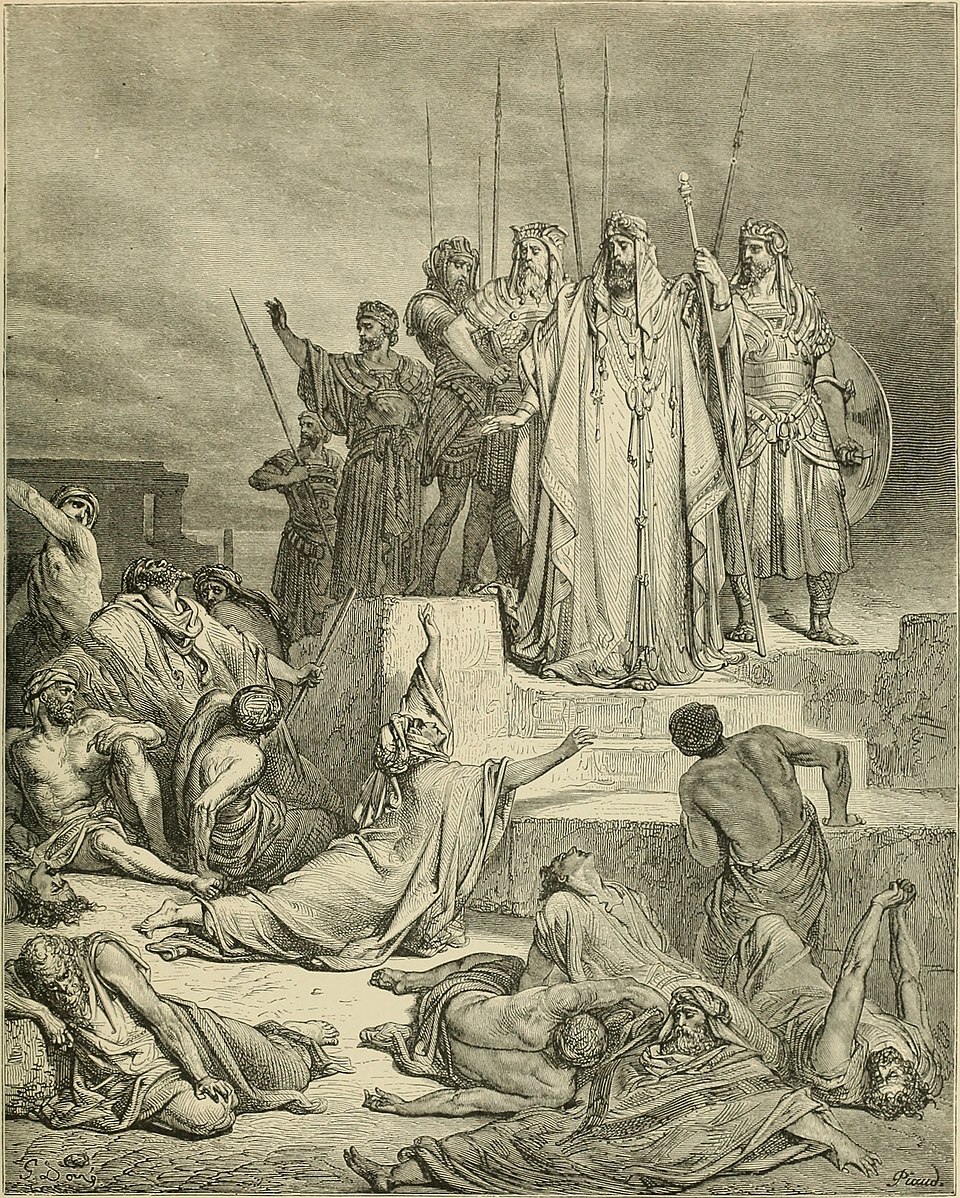
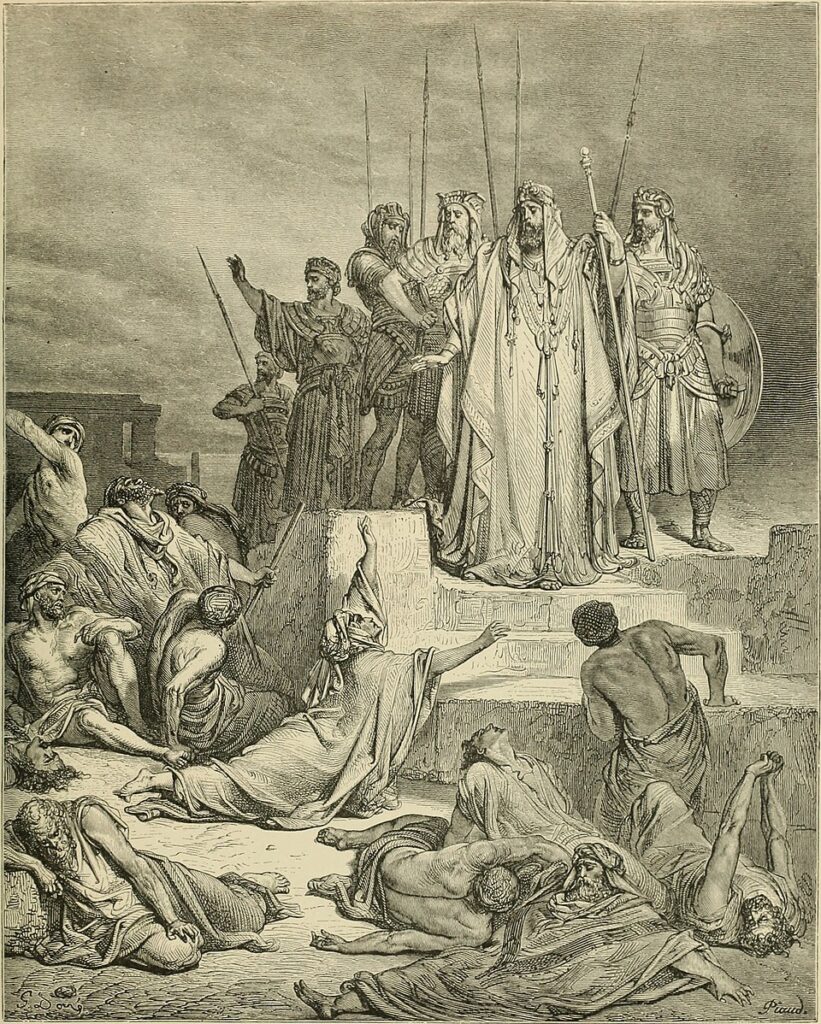
To understand the context better, we must go back to the previous chapter, where we find the chaotic state the people were living in—a famine in Samaria so severe that there were even episodes of cannibalism. The Bible reports that one mother made a pact with another woman, according to which she had to cook her own son to eat, and afterward it would be the other woman’s turn—who then disappeared. Moreover, the situation was so dire that a donkey’s head cost eighty shekels of silver, and about two hundred grams of dove’s dung cost five shekels of silver. It is important to stress that the donkey was an unclean animal under the Mosaic Law, and the head was the least usable part.
In this context, at the beginning of chapter 7, the prophet Elisha proclaims a prophecy that came directly from the Lord:
Then Elisha said, Hear ye the word of the LORD; Thus saith the LORD, To morrow about this time shall a measure of fine flour be sold for a shekel¹, and two measures of barley for a shekel, in the gate of Samaria (2 Kings 7:1).
To paraphrase the prophet: it would be as if, the next day at that very hour, a prime cut of steak cost ten reais and a fine fillet five. In reaction to Elisha’s prophecy, the captain—the right-hand man of the king (probably King Jehoram, son of Ahab)—contradicts the prophet:
Then a lord on whose hand the king leaned answered the man of God, and said, Behold, if the LORD would make windows in heaven, might this thing be? And he said, Behold, thou shalt see it with thine eyes, but shalt not eat thereof (2 Kings 7:2).
Meanwhile, there were four lepers² at the city gate, probably isolated. They communicated by shouting, since they could not approach the others. It is estimated, therefore, that they neither heard nor had any knowledge of the prophet Elisha’s prophecy. Their situation was one of alarming survival; there was no room for apathy. Thus, after reaching a conclusion, they took a course of action that could cost them their lives:
And there were four leprous men at the entering in of the gate: and they said one to another, Why sit we here until we die? If we say, We will enter into the city, then the famine is in the city, and we shall die there: and if we sit still here, we die also. Now therefore come, and let us fall unto the host of the Syrians: if they save us alive, we shall live; and if they kill us, we shall but die (2 Kings 7:3–4).
God is sovereign and depends on nothing and no one to act on behalf of an impossible cause or to perform a miracle. Yet there are decisions that must come from man. Some clear examples in the Bible: Jesus turned water into wine. Only He had that power, but it was man who carried out the task at the waterpots. He healed the paralytic, but He gave the command: “Rise, take up thy bed, and walk.” He multiplied loaves and fish, yet it was two disciples who provided the food. There is also the case of Lazarus. To everyone, Lazarus lay on his deathbed; to Jesus, he was merely sleeping. Four days had already passed; the dead man stank. Jesus is the only One with the power to raise the dead; nevertheless, it fell to man to roll away the stone and unwrap the foul-smelling corpse.
This is the principle the apostle Paul summarizes:
Wherefore, my beloved, as ye have always obeyed, not as in my presence only, but now much more in my absence, work out your own salvation with fear and trembling. For it is God which worketh in you both to will and to do of his good pleasure (Philippians 2:12–13).
The action is ours; the work is His.
Faith moves the supernatural—not because it wrests something from God, but because God, who had already decreed the victory through the mouth of Elisha, chose to act by means of the action of His own. So it was that those four improbable, despised men, upon rising, saw the Lord change the atmosphere, altering the hearing of the Syrian army and granting the victory without weapons and without battles:
And they rose up in the twilight, to go unto the camp of the Syrians: and when they were come to the uttermost part of the camp of Syria, behold, there was no man there. For the Lord had made the host of the Syrians to hear a noise of chariots, and a noise of horses, even the noise of a great host: and they said one to another, Lo, the king of Israel hath hired against us the kings of the Hittites³, and the kings of the Egyptians, to come upon us (2 Kings 7:5–6).
On the miraculous character of the event, Rawlinson comments:
How the noise was produced, it is impossible to say. Natural causes are insufficient, and the author evidently understands the event as miraculous: “The Lord had made the host of the Syrians to hear a noise,” etc. (RAWLINSON, 1909, p. 148–149).
Upon entering the enemy camp, there was no one there, for all had abandoned the territory after the manifestation of God’s power. Faced with this scene, the lepers, who had once stood between life and death, now found themselves in abundance. The narrative says they went from tent to tent, feasted on the finest delicacies, and stored up for themselves precious treasures and garments, so that there was more than enough—even though they were only four. But the blessing they held back would soon weigh on their conscience.
Only moments earlier, they had been asking what course of action they should take in order to survive. They were in a state of urgency. It took but one act of courage, added to faith, for them to experience the best season of their lives. Yet, behold, a thought arises in the midst of the miracle:
Then they said one to another, We do not well: this day is a day of good tidings, and we hold our peace: if we tarry till the morning light, some mischief will come upon us: now therefore come, that we may go and tell the king’s household (2 Kings 7:9).
It was not enough to enjoy the miracle while their compatriots suffered want in their homeland. It was a day of good tidings! Contributing to the understanding of this concept, Edesio Sánchez comments:
The word used here for good news (7:9; besoráh) is the same one the prophet Isaiah will use to announce the LORD’s victory over the Babylonian oppression, and to proclaim the arrival of the year of grace and pardon (Is 40:9; 41:27; 52:7). The lepers became prophets; it is neither the king nor the heralds who proclaim the good news (SÁNCHEZ CETINA, 2022, p. 482–483).
In the period of the Old Testament, the concept of justice was related to the order established by God, to righteousness in relationships, and to the harmony of communal life, involving social, cultural, economic, and political dimensions. This sense was awakened in those four improbable men—excluded and marginalized in the eyes of society. Here a powerful lesson applies concerning the prosperity that comes from God. Drawing an analogy with the hydrography of the Palestinian territory: the Jordan River rises in the north, at the foot of Mount Hermon, and flows down, supplying the famous Sea of Galilee—a freshwater lake, full of life and fish. This lake continues the flow, sharing its waters toward the Judean desert. However, the last sea that receives these waters does not overflow and does not take part in the continuous flow; on the contrary, it only retains. Guess the name of that sea? That’s right: the Dead Sea!
In short, the text goes on, and the outcome of the story is the people reveling in the camp of the Syrians, going from one extreme to the other: from famine and scarcity to abundance and plenty. The crowd was so great that the flow of movement became disordered. Returning to verse two, in which the king’s captain doubted Elisha’s prophecy: he was at the city gate to calm all that commotion and, in the midst of that surge, he was trampled by the people and, consequently, killed. Thus the prophecy was fulfilled: “Behold, thou shalt see it with thine eyes, but shalt not eat thereof” (2 Kings 7:2b).
Therefore, dear brother, may we learn from the lessons of this passage—valuable lessons for our life as a whole. May we never doubt the word that comes from God for our life. We must trust unconditionally; yet we must not merely trust and sit with our arms folded: we have to act! Just as the lepers, who had every reason to give up or to grumble, in that state of emergency between life and death made the decision to react. From that decision, they experienced the greatest miracle of their lives. And, finally, when the miracle comes, do not hold it back! Be a bearer of good tidings. True prosperity is the kind that overflows to others. The psalmist said it long ago: “if riches increase, set not your heart upon them” (Psalm 62:10b). One attitude, one faith: an extraordinary result! May faith and action always walk hand in hand.
Notes
¹ SHEKEL — The basic unit of weight, estimated at about 11.3 grams. The shekel is used in Scripture almost exclusively in contexts dealing with monetary value: whether silver, gold, barley, or flour, valuation in shekels assigns the commodity a relative worth within the economy (ELWELL; BEITZEL, 1988, p. 2137).
² LEPER — a person stricken with the disease of leprosy, 2 Kings 7:8; Mt 10:8. The leper could not associate with healthy people, nor enter the sanctuary; and he was to cry out from afar, “unclean, unclean,” whenever anyone approached him, Lv 13:45; Lk 17:12,13. He was regarded as dead, Nm 12:12. If the leprosy appeared darker and had not spread over the skin, the priest declared him clean, Lv 13:6,12,13. Some expositors hold that, when the disease showed symptoms of being active, the law declared the sufferer polluted; and when it waned with a tendency toward healing, it lost the character of divine curse it had exemplified. Others hold that the leper stricken with the disease over his whole body, as a type of sin, could be admitted to the privileges of atonement. Still other interpreters believe that the rapid manifestation of leprosy over the whole body was a symptom that the crisis had passed and that healing was near (DAVIS, 2005, p. 742).
³ HITTITE — The term Hethite or Hittite (the latter being the form given to it by secular scholars) derives from chittiy, which designates the descendants of Cheth, from which the English term «Hethite» is derived. This word, cheth, means «terror». We can only suppose that this word referred to the terror that savage tribes imposed upon their neighbors, though the reason for such a name is unknown to us (CHAMPLIN, 2013, p. 143).
References
CHAMPLIN, R. N. Hittites, Hethites. In: Enciclopédia de Bíblia, Teologia & Filosofia. São Paulo: Hagnos, 2013.
DAVIS, John. Leper. In: Novo Dicionário da Bíblia. Trad. J. R. Carvalho Braga. São Paulo: Hagnos, 2005.
ELWELL, Walter A.; BEITZEL, Barry J. Weights and Measures. In: Baker Encyclopedia of the Bible. Grand Rapids: Baker Book House, 1988.
RAWLINSON, George. 2 Kings. The Pulpit Commentary. Ed. H. D. M. Spence-Jones. London; New York: Funk & Wagnalls, 1909.
SÁNCHEZ CETINA, Edesio. 2 Reis. In: PADILLA, C. René et al. (org.). Comentário Bíblico Latino-Americano. Trad. Cleiton Oliveira et al. São Paulo: Mundo Cristão, 2022.
THE HOLY BIBLE: King James Version. Cambridge: Cambridge University Press, 1900.